
You’ve got 7 services on your website. Maybe 12. Possibly more, if you count that one thing you do occasionally when a mate asks nicely!
And you want to promote all of them. Of course you do! You worked hard to build each one, and every single service pays the bills. So ,when you sit down to plan your marketing budget, the instinct is to split it evenly and give each offering a fair go. We get that.
Here’s the thing though. Fair isn’t the same as effective. And spreading a modest budget across everything you do is one of the quickest ways to get absolutely nowhere.
Which is why we refuse money. Regularly. Or at the very least, we’ll ask you to reallocate it. When a business comes to Digital Freak wanting 12 services promoted on a budget that realistically supports one, we say so upfront. Sometimes that means turning the work down entirely. More often it means redirecting the spend somewhere it stands a genuine chance of returning something. Not the most lucrative sales approach, admittedly, but it beats sending you a report full of impressions and excuses.
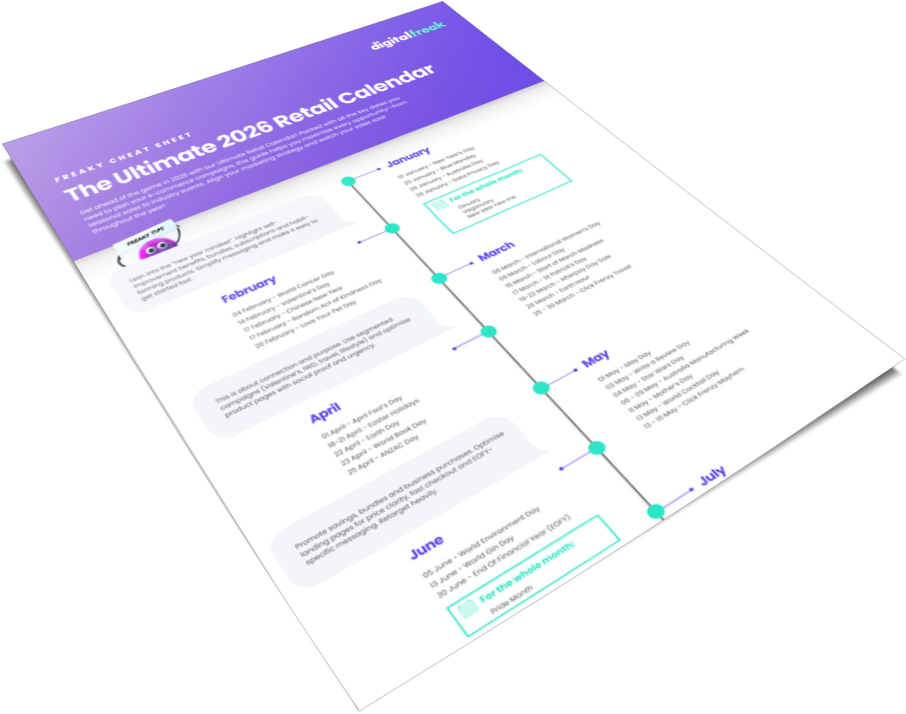
This matters even more right now, with Black Friday and the festive retail season bearing down on us (and why we have this FREE cheat sheet for you for this season!). And this matters for service businesses too, not just retail and e-commerce. Ad costs climb, competition thickens, and every dollar has to work harder than it does in March. Let’s talk about why spreading yourself thin fails, and how to pick the one or two services that’ll actually bring in what you want: Revenue!
Maths… the boring part
Let’s say you’ve set aside $2,000 a month for Google Ads. Feels decent, right? It’s a real commitment, and you’re ready to see some results.
Now split that across 6 services. You’re looking at roughly $333 per service, per month. In competitive industries, a single click can cost anywhere from $5 to $50 depending on the keyword. At the higher end, that $333 buys you about 7 clicks. SEVEN. For the entire month.
And during Black Friday week, when every retailer in the country is bidding on the same terms, those costs can jump significantly. Your $333 stretches even less.
You can’t optimise campaigns on 7 clicks. You can’t A/B test landing pages. You can’t even tell whether the campaign worked or whether someone accidentally tapped your ad while scrolling on the tram.
Google’s algorithm needs data to learn. Most campaign types want somewhere around 30-50 conversions in a 30-day window before the automated bidding really starts performing. Starve it of data and it just guesses, expensively, on your behalf.
The same principle applies to SEO, content, social ads, and pretty much everything else. Marketing has thresholds. Below a certain level of investment, you’re not getting a smaller result. You’re getting no result.
Why concentration beats distribution
Think about a magnifying glass on a sunny day. Spread that light across a wide area and nothing happens. Focus it on one point and you’ve got fire in seconds.
Same energy, wildly different outcome.
When you pick the right fight, concentrate your budget on one or two services, a few good things start happening at once:
You gather usable data. Enough clicks, enough conversions, enough search impressions to actually see patterns. You learn which headlines work, which audiences convert, and which landing pages leak leads.
You build momentum. Search algorithms reward consistency and depth. Twelve shallow pages about twelve services rank for nothing. Four brilliant, genuinely useful pages about one service can own a niche.
You get compounding returns. Once a campaign hits profitability, every extra dollar works harder than the last. You’re no longer paying the learning tax; you’re reinvesting in something proven.
You can actually make decisions. Clear results mean clear choices. Muddy results mean 6 months of “let’s give it a bit longer” while your budget quietly disappears.
How to choose your hero service
Right, so how do you decide which service gets the spotlight and make that $1,000 budget feel like $10,000? Run each one through these five filters and the answer usually becomes obvious.
1. Profit margin, not revenue
This trips up loads of business owners. Your highest-revenue service isn’t necessarily your most profitable one.
A $15,000 project that eats 200 hours and needs three subcontractors might net you less than a $3,000 package you can deliver in a fortnight with existing staff. Work out your actual margin per service, including your own time at a realistic hourly rate.
Promote the service that leaves the most money in your pocket after the work’s done. Not the one with the biggest headline number.
2. Demand that already exists
There’s a massive difference between selling something people are actively searching for and educating a market that doesn’t know it has a problem.
Both can work, but one is dramatically cheaper. If people type “emergency plumber Brunswick” into Google every day, you can capture that intent tomorrow. If you’re selling a service nobody’s heard of or a new brand of clothing no-one knows, you’ll spend months and serious money creating awareness before anyone buys.
Seasonality counts here too. Some services spike hard around the festive retail season, and some go quiet until February. Back the one that matches what people are actually looking for right now, rather than fighting the calendar.
3. Your capacity to deliver
Here’s an uncomfortable question. If your campaign works brilliantly and you get 30 enquiries next month, can you actually service them?
This gets sharper heading into December, when half your team’s on leave and suppliers slow right down. Nothing torches a reputation faster than winning Black Friday work you can’t deliver before Christmas. Promote the service where you’ve got headroom, systems that hold up, and a team that won’t need a lie-down in a dark room by Wednesday.
4. Lifetime value and repeat potential
A one-off transaction is fine. A client who comes back monthly for 3 years is a completely different proposition.
Services with recurring revenue or natural follow-on work justify a much higher cost per acquisition. You can afford to spend $400 winning a client worth $12,000 over time. You can’t afford to spend $400 winning a client worth $500 once.
This is worth remembering when Black Friday discounting tempts you. A cheap one-off sale to a bargain hunter who never returns isn’t much of a win. A discounted first job that leads to years of work absolutely is. And this really matters for service businesses, whether you’re a physio, a landscape maintenance provider, or an accountant.
5. Conversion strength
Which service do you close most reliably? Where’s your proof strongest? Which one has the testimonials, the case studies, the before-and-after photos that make people nod along?
Lead with your strongest closer. Confidence sells, and so does evidence.
The practical allocation model
Once you’ve picked, here’s a sensible way to divide things up.
| Allocation | Where it goes | Purpose |
|---|---|---|
| 70% | Your hero service | Enough spend to hit data thresholds and generate real results |
| 20% | Second service or seasonal push | A controlled experiment or a focused festive campaign |
| 10% | Brand and retention | Email, remarketing, keeping existing clients warm |
It’s critical to give the hero service a genuine run. 3 months minimum for paid ads, six to twelve for SEO and content. Anything shorter and you’re judging a campaign before it’s finished learning.
One caveat on timing. If you’re planning a Black Friday or Christmas campaign, build your audiences and warm up your remarketing lists weeks beforehand. Switching everything on the Thursday before doesn’t work. You’re bidding cold against businesses who’ve been collecting data since September.
Then review properly. Look at cost per lead, lead-to-client conversion rate, and revenue generated. Not impressions. Not clicks. Not likes. Money.
If it’s working, scale it. If it isn’t, you’ve learned something genuinely valuable for a relatively small sum, and you can move to service number two with much better instincts.
Why we’ll sometimes say no to you
Now for the awkward bit.
Sometimes a business owner comes to us with $1,200 a month and a list of 8 services they want promoted nationally. And we’ll say no.
Not because we don’t want the work. Because we’d be taking your money knowing full well it won’t deliver what you’re hoping for. That’s not a client relationship; that’s a slow-motion disappointment with an invoice attached.
We’d rather tell you honestly that your budget suits one service in one city, done properly. Or that your website needs fixing before any ad spend makes sense, because sending traffic to a site that doesn’t convert is like filling a bath with the plug out. Or that you’d get more from a solid month of content and a Google Business Profile tidy-up than from a thin ad campaign.
We’ll also tell you when it’s too late to start something. If someone rings us in mid-November wanting a full festive campaign built from scratch, we’ll be straight with them. Better to run a lean, sharp promotion on one service than a rushed, expensive mess across eight.
Sometimes the honest answer is “not yet, and here’s what to do first.”
We’ve seen too many small businesses burnt by agencies happy to take a small budget, spread it across everything, and produce a colourful report full of metrics that don’t pay wages. Impressions are not income.
A good agency should tell you what won’t work, not just what they can sell you. A GREAT agency should do that AND not charge you an eye-watering fee.
Start narrow, win, then widen
Every business we’ve watched grow well has followed roughly the same path. They picked one thing, backed it properly, made it profitable, then used those profits to fund the next push.
It’s not as glamorous. You won’t be everywhere at once, and that’ll feel uncomfortable for a while. But being genuinely visible for one thing beats being faintly detectable for eight.
Champagne taste is fine. Brilliant, actually. It means you’ve got ambition. Just start with one really good glass rather than watering down the whole bottle.
Pick your hero. Back it properly. Then go again.
Stop spreading thin, start seeing revenue results
Your marketing budget shouldn’t feel like a “close your eyes and make a wish” moment. At Digital Freak, we’ll help you identify the one or two services worth backing, build campaigns that bring in revenue, and tell you honestly when something won’t work. We’re a Melbourne agency built for small and medium businesses who want bottom-line results, not pretty reports. Ready to stop spreading yourself thin? Book a free strategy call with our director, Karyn Szulc, and let’s pick your hero service together.
FAQs
How much should a small business realistically spend on digital marketing each month?
There’s no magic number, but a useful benchmark is 5 to 10% of revenue, with growth-focused businesses pushing higher. What matters more is concentration. A focused $1,500 on one service beats a scattered $3,000 across six. We’ll help you work out a figure that suits your goals and cash flow. Book a free strategy call with our director, Karyn Szulc, and we’ll run the numbers with you.
How long before I see results from Google Ads?
Expect two to four weeks for initial data, and around three months before performance genuinely settles. The algorithm needs conversions to learn, so patience pays. Anyone promising overnight results is selling you something. Our Google Ads management focuses on sustainable, measurable returns rather than vanity spikes. Want an honest forecast for your industry? Reach out and we’ll talk you through it.
Should I do SEO or paid ads first with a small budget?
Paid ads deliver faster, SEO compounds over time. If you need leads this quarter, start with ads. If you’re playing a longer game and can wait 6-12 months, SEO builds lasting value. Most businesses eventually want both. We offer both services and will recommend whichever suits your timeline. Get your free strategy call with our director, Karyn Szulc, to find out which fits you.
My website isn’t converting. Should I still run ads?
Honestly? No. Sending paid traffic to a website that doesn’t convert wastes money every single click. Fix the foundations first, then turn the taps on. Our web design and development team builds sites designed to convert, not just look pretty. Let’s audit your site before you spend another dollar on advertising. Send us a message to get started.

When clients work with me, they get exactly what they want - no-nonsense, authentic digital marketing that works! With my industry experience, eye for detail, and a team that goes the extra mile, every client gets the personalised, expert treatment they deserve. Let’s get you online – and growing!