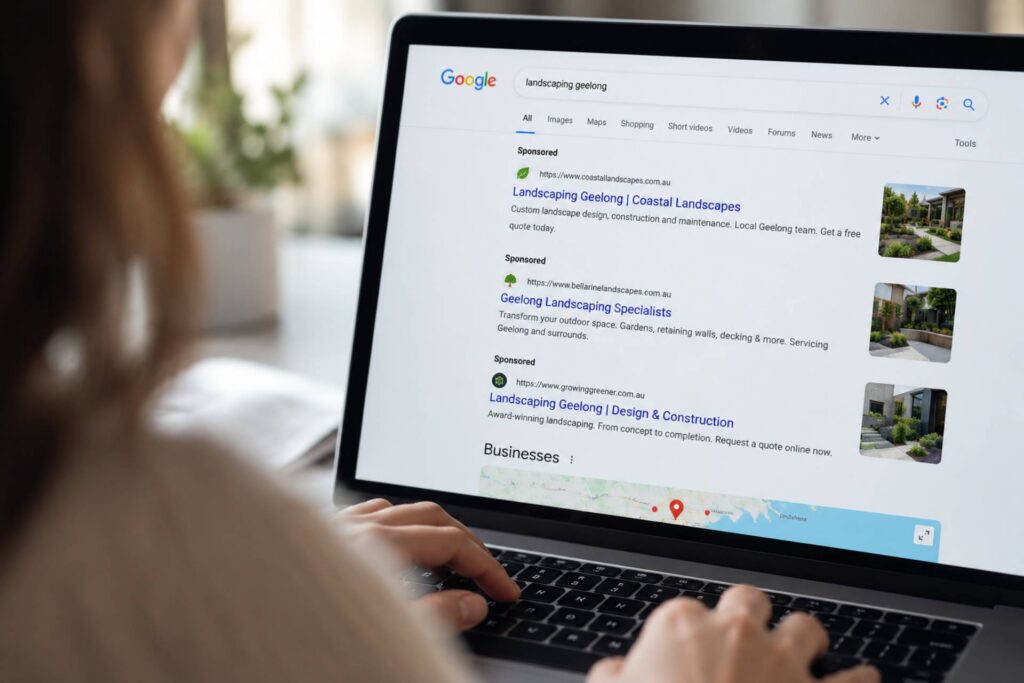
You Google your own business, just to check. You scroll down, then scroll again. Your ad isn’t there, even though you pay for it every month.
Then a customer tells you they found your ad straight away. A friend says they searched and couldn’t see it anywhere. So which is it?
It can be both, and it usually doesn’t mean anything is broken with your Google Ads. Google decides who sees which ads based on things like budget, location, timing and even how often you’ve searched without clicking. Most agencies never explain this, so it’s no wonder so many business owners wonder where their money is going!
The Google auction process
A lot of business owners picture Google Ads like a billboard: you pay a fixed price, and your ad sits in the same spot all month. It doesn’t work that way.
Every search starts a brand new auction, and it’s over in a fraction of a second. This happens all day, every day, for every search. Each results page only has a few ad spots, and sometimes Google decides not to show any ads.
Paying the most doesn’t automatically put you on top. Google looks at:
Your bid.
The most you’re willing to pay for a click compared to other businesses
Quality and relevance.
How closely your ad and landing page match the search, and how likely people are to click
The searcher’s situation.
Their location, device, the time of day and the exact words they typed
Extra details in your ad.
Things like your phone number, service area and links to specific services
Google wants people to find useful results, so they keep using Google. That’s why a small local business with a relevant ad can beat a bigger competitor who spends more on a generic one.
An example:
Someone in Geelong searches “switchboard upgrade electrician Geelong.” A local electrician’s ad says, “Switchboard Upgrades, Licensed Geelong Electricians” and links to a page about switchboard upgrades. A national franchise’s ad sends people to its general homepage. The local electrician has a real advantage and can win the spot even with a lower bid.
It works the same way for an accountant. An ad for “Small Business Tax Returns, Ballarat Accountants” that links to a page about small business tax will usually do better than a vague ad for “Accounting Services Australia-Wide.”
This is also why nobody can promise you a spot just because you spend more. A bigger budget improves your chances, but it doesn’t guarantee anything.
You also only pay when someone clicks. Showing up is free, and you usually pay a little less than your maximum bid, because Google only charges enough to beat the next advertiser.
“I Searched for Myself and Couldn’t See My Ad”
This is the question business owners ask most. Here’s what’s usually going on.
The search was too vague.
Take a bakery that makes custom birthday cakes. Someone who searches just “cake” might want a recipe, ideas, the nearest supermarket or a shop in another city. Very few of them want to order a $250 custom cake today.
Someone searching “custom birthday cake order Parramatta” is a different story. They’re ready to buy. A sensible campaign skips the vague searches and focuses on the specific ones. That’s deliberate, not a mistake.
The same applies to lots of businesses:
- An accountant doesn’t want to pay for “tax”, which mostly brings people looking up ATO rules.
- An electrician doesn’t want “light switch”, which mostly brings DIYers and shoppers.
- A wedding photographer gets little from “wedding”, which covers dresses, venues and ideas.
The day’s budget had run out.
Every campaign has a daily budget. Once it’s spent, the ads stop until tomorrow. If you spend $30 a day and clicks cost about $10, that’s about three clicks. If they all happen by 10am, anyone searching after that won’t see you.
Google also doesn’t spend exactly the same amount every day. It may spend more on busy days and less on quiet ones, but over a month it won’t spend more than your daily budget × about 30.4.
You’re outside the target area.
Local businesses usually show ads only where they work. A landscaping business in Brisbane’s Moreton Bay doesn’t want to pay for clicks from Parkinson. If your sister searches from another suburb or city, she may not see you.
The ad is scheduled for certain times.
Some campaigns only run during business hours or put more budget into the times when enquiries are most likely. If you search at 11pm, the ad may simply be switched off.
Google has learned you won’t click.
If you search for your own business over and over without clicking, Google may decide you’re not interested and stop showing you the ad. Checking your own ads can actually make you see them less. It also adds views to your results that aren’t real customers. Use the free Ad Preview and Diagnosis tool in Google Ads instead or ask your agency for a screenshot.
Everyone sees something slightly different in results.
Location, device, past searches and wording all change the results. Even two people sitting side by side can see different pages.
Why small budgets need to be choosy
This isn’t a criticism of small budgets. It’s simply how auctions work.
When lots of businesses want the same customers, the price per click goes up. Here’s a simple way to work out what your budget buys:
Daily budget ÷ cost per click = roughly how many clicks you get each day
For example, on a $30 daily budget:
- $3 per click: about 10 clicks a day
- $5 per click: about 6 clicks a day
- $15 per click: about 2 clicks a day
In very competitive fields like law, finance or emergency trades, one click can eat most of a day’s budget.
With so few chances, every click needs to count. If you try to show up for everything, the money runs out on people who were never going to buy. It’s better to put your money into your best performing ad and reach 10 people ready to book than a hundred who are just browsing.
What this looks like in practice:
- A physio on a small budget might focus on “sports physio [suburb]” and “physio open Saturday” rather than “back pain”, which brings lots of people looking for stretches to do at home.
- A locksmith might focus on “locked out” and “emergency locksmith” searches, where people need help right now.
- A tutor might focus on “year 12 maths tutor [area]” rather than “maths help”, which mostly brings students looking for free answers.
Why your industry matters
Two businesses can spend exactly the same and get very different results. It usually comes down to three things.
How many people search for what you do
A dentist in Sydney has people searching for appointments every day of the year. A piano restorer in a smaller town in Victoria might see only a few searches a month. If people aren’t searching, a bigger budget can’t create them.
How many competitors are bidding
Dentists, removalists, conveyancers and solicitors are often up against lots of rivals, including big chains and lead-buying websites. That pushes prices up. A niche business, like a vintage sewing machine repairer, may get cheap clicks with little competition, but also fewer searches.
What a customer is worth to you
A solar installer might earn thousands from one job, so paying a lot per click can still make good sense. A café selling $6 coffees usually can’t make paid clicks pay off. A dog groomer earns less per visit, but a happy customer can come back every six weeks for years, so each new client is worth much more than the first appointment.
Timing matters too. Air conditioning repairers get busy in heatwaves. Accountants get busy around tax time. Wedding photographers see interest jump after the holidays and engagement season. The same budget can perform very differently depending on the month.
To see the benchmark for your business, this a great free sector-based benchmarking tool to use!
Will spending more guarantee results?
No. But it usually helps, up to a point.
Think of it like picking fruit. The fruit on the lowest branches goes first. To get more, you have to reach higher, which takes more effort. In Google Ads, your first dollars usually win the best, most ready-to-buy searches. Extra budget often goes on slightly pricier or less certain clicks. So doubling your budget might not double your leads.
A few honest points to keep in mind:
- There has to be enough demand.
In a small town, there may not be enough searches to spend more money well.
- You need to be able to handle the work.
- More leads only help if someone answers the phone quickly and has time to do the jobs. A missed call often goes straight to the next business on the list.
- Be wary of guarantees.
- Anyone who promises a set number of leads from Google Ads is promising something nobody controls.
The best guide is your own numbers
Look back over the last six months. How many enquiries did you get? How many became paying jobs? What’s a typical job worth? If roughly every second enquiry becomes a $500 job, each enquiry is worth about $250 to you. That tells you what you’re comfortable paying for one. If you want to grow, increase the budget gradually and watch what happens. It’s how you make a small budget get the results of a big one.
Two numbers you need to watch
You don’t need to understand every report. Two numbers tell you the most important information:
- Click-through rate: Of the people who saw your ad, how many clicked. This shows whether your ad appeals to the right people.
- Conversion rate: Of the people who clicked, how many called, booked or filled in a form. This shows whether those clicks are turning into real enquiries.
If both look healthy, your money is reaching the right people, even if your friend didn’t see your ad.
What’s different about Google Ads in 2026
Because of AI, Google is changing very quickly and is likely to change even more over the next few years. That affects where and how ads appear.
AI Overviews
Google often shows an AI-written summary at the top of results, especially for questions like “how often should a hot water system be serviced”. That pushes ads further down for general information searches. Searches with clear buying intent, like “hot water repairs near me”, are still where ads tend to work best.
AI Mode
Google also offers a chat-style search where people ask longer, more detailed questions, like “who’s a good family dentist near me that’s open Saturdays?” That means ads are matched to what someone means, not just the exact words they type.
Ads inside AI answers
Google has been adding ads within and around AI-generated answers. How this works in Australia is still developing.
More automation
Google increasingly uses AI to decide which searches an ad appears for, beyond the exact keywords chosen. This can find new customers, but it makes careful setup and regular checks of the actual search terms more important, especially on small budgets.
Google updates these features often and doesn’t share every detail, so it’s worth checking its official help pages for the latest.
The short version
- Not showing up for every search is normal, and it’s often deliberate.
- Google Ads runs a fresh auction for every search. Bid, relevance, location and budget all matter.
- Small budgets mean fewer chances each day, so focusing on ready-to-buy searches gets the most value.
- Every industry has different search demand, competition and job value, so results vary.
- Spending more usually brings more leads but never guaranteed ones. Your own numbers are the best guide.
- Checking your own ad over and over can work against you. Use the Ad Preview tool instead.
Google Ads, without the smoke and mirrors
Google Ads isn’t magic, but it isn’t a mystery either. Once you know how the auction works and why your own ad sometimes goes missing, you can make smarter choices about where your money goes. A bigger budget won’t fix a weak setup. A small budget, spent well, can go a long way.
You don’t need another agency trying to upsell you everything under the sun. You need someone who’ll tell you honestly what will work best as your Google Ads strategy to drive revenue for your business. That’s us. Digital Freak helps Melbourne businesses make every marketing dollar count. Book a free strategy call with our director, Karyn Szulc. There’s no sales pitch and no pressure.
FAQs
Should I pay for ads when people search my business name?
Often, yes. Searching your name doesn’t mean someone has decided to choose you. Competitors can show ads on your name, so a customer who means to call you might end up calling someone else. Clicks on your own name are usually cheap because your ad is the most relevant one. Whether it’s worth it depends on who you’re up against. Book a free Google Ads strategy call and we’ll check who’s competing for your name.
A competitor’s ad shows up when people search my business name. Is that allowed?
In most cases, yes. Businesses are generally allowed to bid on a competitor’s name as a search term. Using your registered trademark in their ad text is a different matter, and you may be able to report it to Google. Don’t panic, though. A clear, relevant ad of your own usually wins the customer back. Talk to our team (it’s free) about protecting your brand on Google.
What happens if I pause my ads for a few weeks?
Your ads stop showing straight away, and so do the enquiries they bring in. When you switch back on, Google’s automated bidding may need some time to settle again, so results can be patchy at first. If you’re busy or short-staffed, lowering the budget or limiting the hours is often better than switching off completely. Get a free call with or Melbourne agency before you pause, and we’ll help you pick the best option.
Do I need a separate landing page, or can ads just go to my homepage?
A focused landing page almost always does better. If someone searches “emergency roof leak repair” and lands on a general homepage, they have to go looking for what they need, and many won’t bother. A page that matches the search, with a clear phone number, real photos and reviews, turns more clicks into calls. Talk to the person who runs the agency, not a salesperson. Book a free call with our Melbourne agency’s director, Karyn Szulc, and get straight answers about your Google Ads.

When clients work with me, they get exactly what they want - no-nonsense, authentic digital marketing that works! With my industry experience, eye for detail, and a team that goes the extra mile, every client gets the personalised, expert treatment they deserve. Let’s get you online – and growing!