
You’ve probably heard the old saying about marketing. Half of it works, you just don’t know which half.
That’s more than an annoying cliché. It’s a real threat to cash flow. When your budget and margins are tight, every dollar spent on Facebook ads, Google search campaigns, or your website, is a dollar that could’ve paid for staff or stock, helped pay for a family holiday, or simply stayed in the bank.
Working out whether your marketing spend is profitable means looking past vanity metrics and getting comfortable with the hard numbers in your business. It’s time to stop treating marketing as a cost you can’t avoid and start treating it as an investment that’s expected to pay you back.
Likes aren’t dollars in the bank
Online, it’s very easy to get distracted by certain data, often by their marketing agency. Your dashboard tells you you’ve had 10,000 impressions, 500 clicks and 50 new followers this week. These are what we call vanity metrics. They feel important and they look great in a report, but they rarely turn straight into profit. All they’re doing is making your marketing agency more money because you’ll be more likely to stick with their high costs.
A lot of small businesses fall into the trap of mistaking activity for profit. A high clickthrough rate doesn’t mean much if those clicks don’t become sales. To find out whether you’re making money, focus on the numbers that are tied directly to revenue.
Customer acquisition cost (CAC) is the average amount you spend to win one new paying customer. If you spend $200 on ads and get two customers, your CAC is $100.
Lifetime value (LTV) is the total revenue a customer brings in over their whole relationship with your business. If they buy once and vanish, it’s low. If they come back every month for two years, it’s high.
Return on ad spend (ROAS) is a short term measure of how much revenue a particular ad campaign brings in for each dollar you put into it.
If your CAC is $100 but a customer only spends $80 on their first purchase, you’re losing money on every sale, unless they come back and buy again. That’s the detail many automated marketing tools don’t explain.
Why it’s hard to know which marketing worked
If measuring ROI were as simple as watching money go out and come back in, every business would be profitable. In reality it’s much messier. This is known as the attribution problem.
Picture a customer in Bunbury, in regional Western Australia. They see your brand on Instagram while they’re scrolling in bed on a Tuesday. They don’t click. On Thursday they search Google for your type of product and land on your website. They don’t buy. Then on Saturday your email newsletter arrives, and they finally make a purchase.
So which channel gets the credit? Instagram, Google, or email? If you only looked at the last click, you’d think email was doing all the work and you might cancel your Instagram ads. That’d be a mistake. The customer needed all three touchpoints before they were ready to buy.
For most small businesses, the complex attribution models big companies use are overkill. Watch the overall trend instead. If you switch off a channel and your total revenue drops noticeably over the following month, that channel was probably more profitable than your basic tracking suggested.
The irritating thing is that many digital agencies don’t make this any easier. You get a monthly report packed with impressions, reach and click through rates, and somehow every channel looks like a winner. Each platform also likes to take credit for the same sale. Add up what Google, Meta and your email tool each claim, and you can end up with more “conversions” than actual customers. Sometimes it’s an honest muddle. Other times a confusing report is simply easier to defend than a clear one.
A good agency should be able to tell you exactly which channels are bringing in paying customers and which ones aren’t. If yours can’t, or keeps steering the conversation back to likes and engagement, it’s fair to ask why.
Awareness and conversion play different games
Not all marketing is meant to make a sale straight away!
Conversion marketing is designed to get a sale or enquiry now. These campaigns should have a clear ROAS you can measure. Here’s how that might look for a few different businesses.
- A logistics company runs Google search ads that appear when an operations manager in Adelaide types “same day freight Adelaide”.
- A tax accountant in Parramatta runs ads in July and August that target people searching “tax return accountant near me”.
- An aesthetics clinic in Brisbane uses retargeting ads to show a skin treatment offer to people who’ve just looked at that page on its website.
Each of these is aimed at someone who’s ready to act. You can track the clicks, the enquiries and the bookings, then match them against what you spent.
Awareness marketing builds trust and recognition. It’s harder to measure in the short term, but it’s often what makes people choose you when they’re finally ready. For the same businesses, it might look like this.
- The logistics company posts LinkedIn articles about cutting freight costs or making supply chains more efficient. A warehouse manager might not need a new carrier today, but they’ll remember the name when their contract’s up for renewal.
- The tax accountant writes helpful blog posts about deductions for tradies, or sponsors the local footy club in Geelong. It probably won’t win a client this week, but it makes them the familiar, trusted name when tax time comes around.
- The aesthetics clinic shares educational videos about what treatments actually involve, along with honest before and after stories (within the advertising rules for cosmetic procedures). People rarely book a treatment the first time they hear about a clinic. They usually want to feel confident first.
If you judge awareness marketing the same way you judge conversion marketing and expect a sale within a day, you’ll decide it isn’t working and cut it. That hurts your growth over the long term. This matters even more for businesses with long decision cycles. A logistics contract can take months to land, and a new accounting client might only switch once a year.
Most small businesses should lean heavily on conversion marketing until they’ve got steady revenue coming in, then gradually add awareness campaigns to reach more people
A quick audit you can do yourself
You don’t need an expensive consultant to check whether your marketing’s paying off. You can start with an honest look at what you’re spending now.
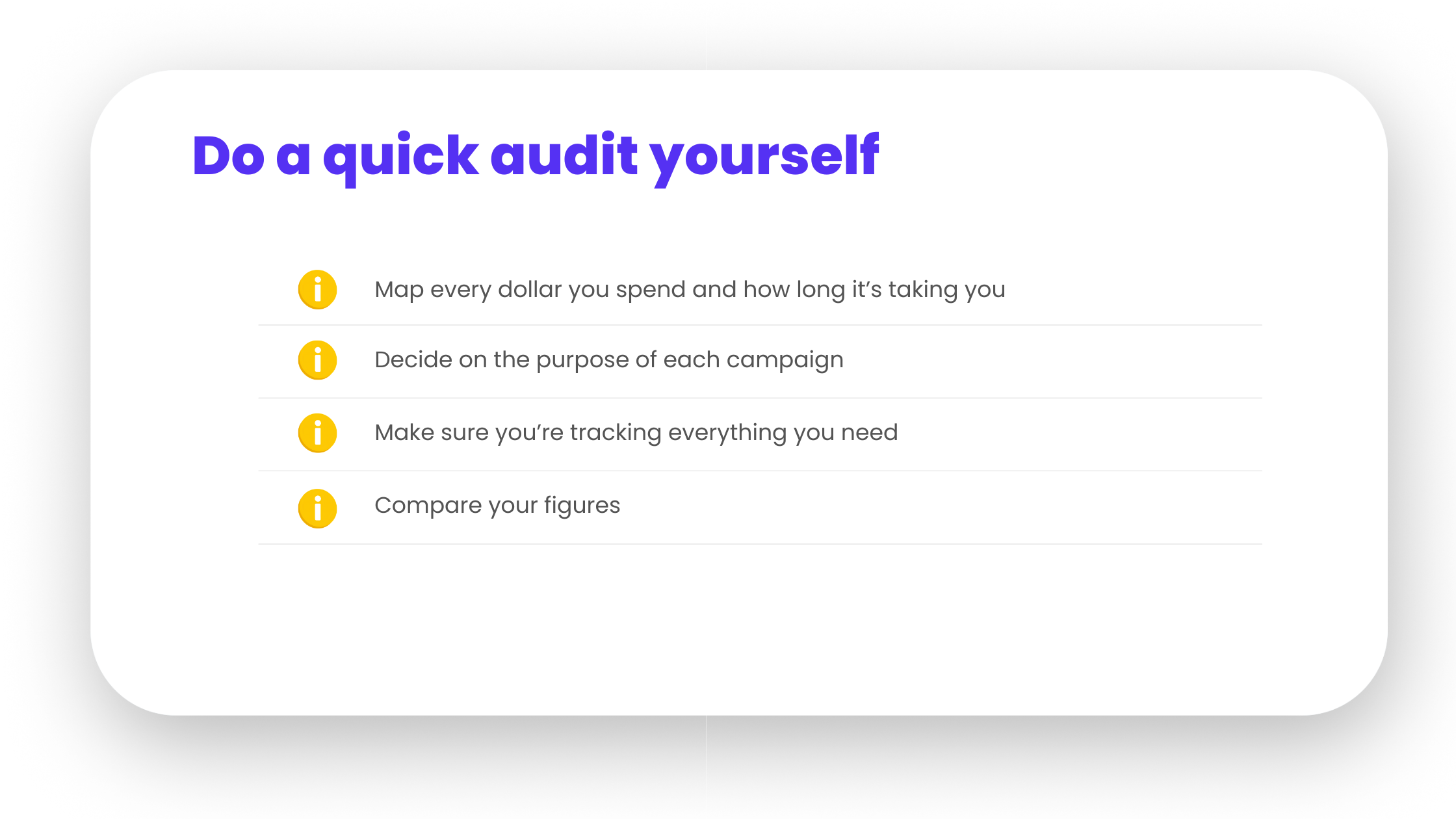
- Map every dollar. List every marketing cost, including the time you spend on it. If you spend five hours a week posting on social media, work out what that time’s worth at your hourly rate.
- Decide what each campaign is for. Ask whether it’s meant to get a sale today or build your brand. If it’s about sales, it needs a clear link to a dollar figure.
- Set up tracking properly. If you’re running digital ads, use tracking pixels or UTM parameters. These are simple tags that show which ad or link led to a sale. If you’ve got a shopfront in Hobart or a salon in Newcastle, ask customers how they found you, or give each channel its own discount code.
- Compare what comes in with what goes out. Put the total revenue a channel brings in next to its total cost, including your time.
If a channel costs more to run than the profit it brings in, and it isn’t giving you real brand value you can measure, stop it. There’s no room for sentiment here.
What you can’t control and when to get advice
How well your marketing works often depends on things you can’t control. Seasons, changing customer habits, what your competitors are doing, and wider economic shifts can turn a profitable campaign into a money pit almost overnight.
Digital marketing is something you keep improving, not something you set up and forget. It needs regular checking and testing.
Marketing should be the engine that grows your business, not the anchor holding it back. Once you stop looking at vanity metrics and focus on what you spend compared with the profit it actually brings in, you’ll stop hoping your marketing works and start knowing exactly where your money’s going and why. Frankly, even a $1,000 budget can work as well as a $10,000 one!
Make your marketing earn its keep
Marketing shouldn’t feel like feeding coins into a pokie machine. Once you know your CAC, LTV and ROAS, you can make much smarter calls.
But let’s be honest, you’ve already got a business to run. That’s where Digital Freak comes in. We’re a small business too, so we focus on helping small and medium businesses across Australia, from law firms, ecommerce businesses and clinics to logistics companies and cafés, work out what’s working and ditch what isn’t.
No jargon, no fluffy reports, no sneaky upsells. Want to know where your money’s really going? Book a chat with our director, Karyn Szulc. It’s no obligation!
FAQs
My marketing doesn’t seem to work. Should I just stop?
Don’t stop suddenly without a plan. We’ll even help you out with a free strategy call. We recommend you start by checking your campaigns are actually reaching the right people. Sometimes the channel isn’t the problem; the message or the offer is. Pause the campaigns that aren’t performing, adjust them based on whatever data you’ve got, and test a smaller, more focused campaign before you give up on marketing altogether.
How long should I wait to see if a campaign is profitable?
It depends on what the campaign’s for. Conversion ads should start showing results fairly quickly, usually within a few weeks of testing and tweaking. Awareness campaigns take much longer, often months, because they work by building trust over time. So don’t judge an awareness campaign on last week’s sales. Look at longer trends in website traffic, enquiries and people searching for your brand name. Want clear answers without the upsell and BS? Book a free call with our director, Karyn Szulc.
Is paid advertising better than organic social media?
Neither is better on its own because they do different jobs. Paid ads on Google or Meta are usually better for quick, targeted sales. Organic social media is better for building relationships and trust, which keeps customers coming back. For many small businesses, the mix that works best is paid ads to bring in new customers and organic social to keep them interested. Get it right and stop wasting your budget!
Should I hire my own marketing team, a marketing manager, or work with an agency?
It depends on your business size and budget. Hiring your own team gives you people who know your business inside out, but salaries, software and training add up fast. One person also can’t be an expert in design, ads, SEO and content all at once. An agency gives you a whole team of specialists for less than the cost of one full time hire. In fact, our Melbourne agency regularly work with budgets in the $1,000-2,000 range. If you’re weighing up your options, book a no-obligation chat with our director, Karyn Szulc, and we’ll give you an honest view, even if that means we’re not the right fit.

When clients work with me, they get exactly what they want - no-nonsense, authentic digital marketing that works! With my industry experience, eye for detail, and a team that goes the extra mile, every client gets the personalised, expert treatment they deserve. Let’s get you online – and growing!