

If you’re running a small or medium-sized business online, choosing the right ecommerce platform matters. The platform you pick affects your day-to-day workload, how quickly you can respond to opportunities, your marketing and SEO potential, and ultimately how fast you can grow. Two of the most popular choices are Shopify and WooCommerce. Both platforms are excellent and widely used, but each with a different approach to scaling.
So, here’s how Shopify and WooCommerce stack up for businesses that want to scale and increase conversions. We’ll cover technical setup and maintenance, design and customisation, integrations and apps, payments and fees, inventory and fulfilment, SEO and marketing, developer resources, and real-world cost and time considerations.
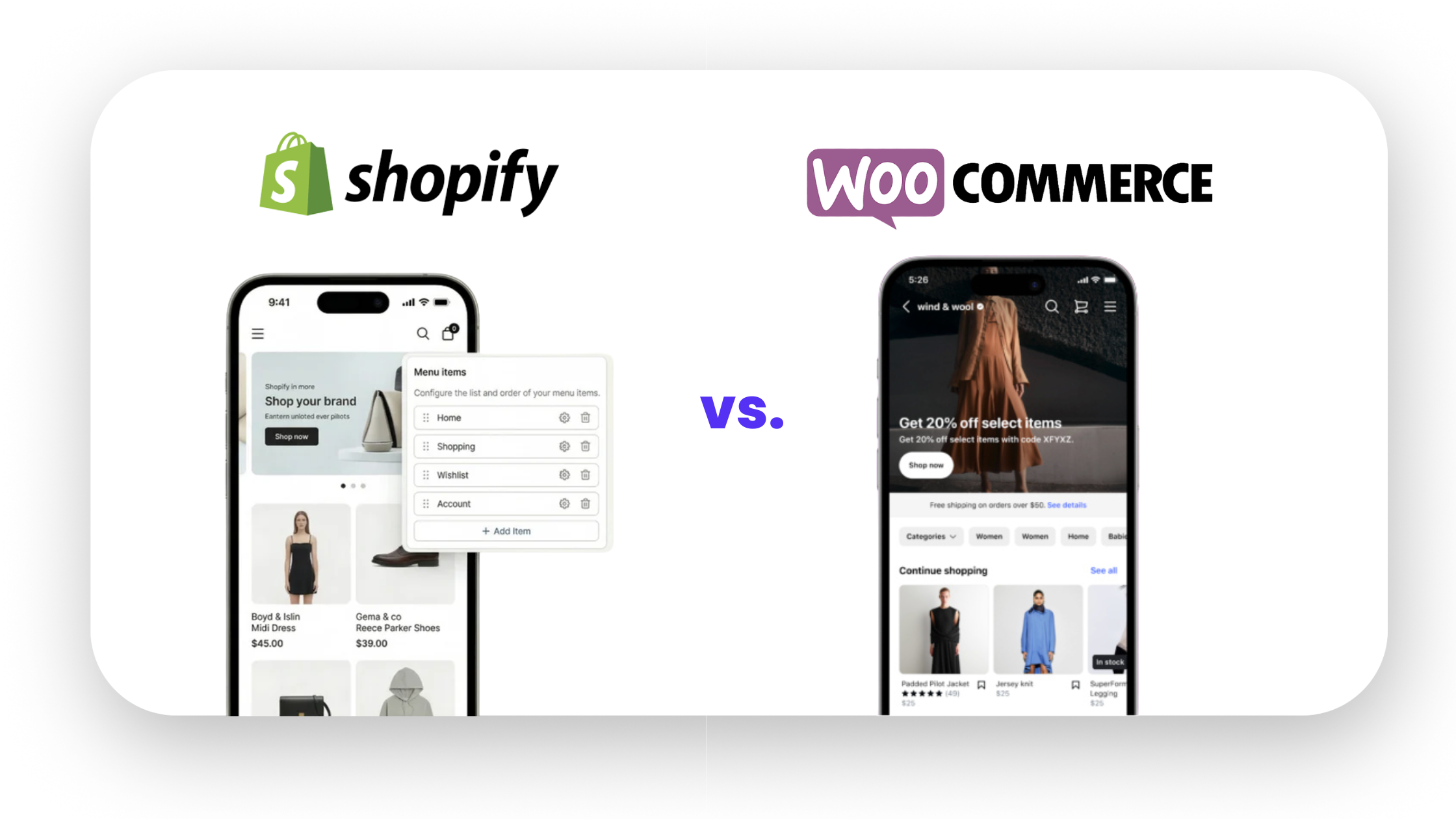
Platforms at a Glance: Hosted vs Self-Hosted
- Shopify: A hosted, all-in-one platform. Shopify runs the servers, maintains security updates, and handles PCI compliance. You log in, build your store, and Shopify takes care of the underlying tech.
- WooCommerce: A plugin for WordPress, which is self-hosted. That means you choose your hosting, manage updates, and piece together plugins (for payments, shipping, backups etc.) to build a shop.
Why it matters for scaling: with Shopify you offload operational tech work and can focus on growth activities. With WooCommerce you keep more control and flexibility, but you also own the infrastructure, which can add complexity as you scale.
Speed to Market and Ongoing Speed of Iteration
- Shopify: Quick to launch. The onboarding process is tight, the admin is built for commerce, and standard tasks (adding products, setting discounts, launching sales) are straightforward. Launching a basic store can be a matter of days.
- WooCommerce: Can be fast if you have WordPress experience, but assembly is required. Hosting, security, caching, and plugin compatibility all influence launch time.
Why it matters for scaling: When your focus is scaling, the ability to iterate fast matters. Shopify’s unified environment makes it easier to test new pages, promotions, and sales funnels without chasing plugin conflicts or server issues. On the flip side, WooCommerce gives you deeper control over every part of the site, which is great if your growth depends on bespoke features or integrations.
Maintenance, Reliability and Technical Overhead
- Shopify: Maintenance-light. Shopify manages uptime, platform updates, security patches and compliance. That reliability is huge when you’re scaling and don’t want tech fires taking you away from growth.
- WooCommerce: Maintenance-heavy if you do it yourself. Hosts vary in quality; plugins need updates; security and backups fall on you or your developer. Managed WordPress hosting reduces friction but increases cost.
Why it matters for scaling: For scaling, downtime and slow pages hurt conversion. Shopify’s model reduces the chance of technical problems slowing growth. WooCommerce can be equally reliable with the right hosting and processes, but it requires more ongoing attention.
Design, Customisation and Brand Control
- Shopify: Plenty of high-quality themes, a visual editor, and Liquid templating for developers. It’s geared to give great results quickly and maintain brand consistency.
- WooCommerce: Total design freedom via WordPress themes and page builders like Elementor or Gutenberg. If you want full control over markup, UX, or highly customised checkout flows, WooCommerce can be more flexible.
Why it matters for scaling: If scaling means running lots of campaigns and landing pages, Shopify’s Theme and Sections approach is fast and predictable. If scaling relies on heavily customised customer journeys. For example complex product configurators or highly bespoke checkout logic, WooCommerce (or a Shopify Plus custom app) might fit better.
Apps, Integrations and Growth Tools
- Shopify App Store: Thousands of apps for marketing, subscriptions, loyalty, B2B features and more. Installation is usually straightforward and supported across themes.
- WooCommerce extensions: Also abundant, but quality varies and compatibility depends on your WordPress setup. You can integrate practically anything, but you sometimes need a developer to stitch things together.
Why it matters for scaling: For growth, you’ll likely need CRM integrations, email automation, subscription tools, marketplaces, and analytics. Shopify offers a smoother path to plug-in-and-play tools; WooCommerce gives you options but often demands more technical glue work.
Payments, Fees and Financial Scaling
- Shopify: Supports major payment gateways and offers Shopify Payments (available in Australia) which simplifies payout and reduces third‑party gateway fees. Note that using non-Shopify gateways can trigger additional Shopify transaction fees unless you’re on higher-tier plans.
- WooCommerce: Truly gateway-agnostic. Any gateway with a WordPress plugin will work, and you avoid platform transaction fees. However, depending on your gateway and merchant rates, fees may still add up.
Why it matters for scaling: When scaling, transaction volume affects fees significantly. Shopify Payments is convenient and often competitively priced for many merchants. For businesses with specialised payment needs or very tight margins, WooCommerce’s flexibility to choose any gateway can be an advantage.
Inventory, Fulfilment and Multichannel Selling
- Shopify: Robust out-of-the-box inventory management, native sales channels (Shopify POS, Facebook/Instagram, marketplaces), and simple fulfilment app options. It’s designed for multichannel sellers to manage stock and orders in one place.
- WooCommerce: Plenty of powerful inventory and fulfilment plugins, but connecting everything often requires configuration and testing. Integrations with marketplaces and POS exist, but the experience depends on the plugins and host.
Why it matters for scaling: If your scaling plan includes rapid expansion to marketplaces or brick-and-mortar, Shopify’s integrated approach reduces headaches. WooCommerce can do the same but may need extra build time.
SEO, Content and Marketing Capability
- Shopify: Shopify has improved a lot for SEO, with clean URLs, meta control, schema, and blog functionality. It’s simple to set up and maintain SEO best practices.
- WooCommerce: Benefits from WordPress’ content-first architecture. If content marketing and blogging are central to your growth, WooCommerce offers a lot of power and flexibility for complex content strategies.
Why it matters for scaling: For many businesses scaling via paid ads plus content, Shopify provides everything needed to rank and convert. If your strategy is highly content-driven with deep blog-based funnels, WooCommerce’s wordsmith-friendly CMS might give you an edge.
Developer Ecosystem and Customisation at Scale
- Shopify: An active developer ecosystem and a clear app architecture. Shopify Plus (enterprise tier) offers additional APIs and support for high-growth merchants.
- WooCommerce: Massive WordPress developer community and near-infinite customisation possibilities. But custom code often requires ongoing maintenance.
Why it matters for scaling: If scaling means building custom platforms or complex integrations, WooCommerce (and WordPress) give almost full control. Shopify keeps pace for most SMB growth needs and feels simpler when you need reliable, maintainable customisations without endless maintenance.
Cost of Scaling
Let’s look at three simplified growth scenarios for comparison:
Small boutique scaling locally (volume grows to a few thousand monthly orders)
- Shopify: Basic plan → potentially upgrade to Shopify (or Advanced) as volume grows; low technical overhead.
- WooCommerce: Managed hosting + backups + security + developer support; lower platform fees but fixed hosting and maintenance costs.
Fast-scaling brand selling subscriptions and bundles
- Shopify: Subscription apps available; predictable costs and performance. May need additional app fees.
- WooCommerce: Subscription plugins exist and can be cheaper per month but may require developer maintenance and extra hosting resources during peaks.
Complex B2B/wholesale setup with bespoke pricing and custom checkout
- Shopify: Shopify Plus or apps/custom apps can accomplish this but at higher cost.
- WooCommerce: Easier to implement bespoke pricing flows on the platform without enterprise pricing, though it may need a developer to build and maintain.
Key takeaway: Shopify generally offers predictable, scalable costs and less technical risk. WooCommerce can be cheaper upfront and more flexible, but you should factor in ongoing developer and maintenance costs as well as the need for reliable hosting as traffic grows.
Migration and Future-Proofing
If you start small on WooCommerce and want to migrate later, moving to Shopify is doable but requires planning, including product and customer exports, URL redirects, and theme rebuilds. Moving from Shopify to WooCommerce is also possible but involves similar migration work. The best approach is to pick the platform that matches your growth strategy today and in the near future, not the one that looks cheapest on day one.
Which Platform Helps You Focus on Growth?
If your priority is to reduce technical overhead, iterate quickly, and scale without building an in-house ops team, Shopify’s hosted model is a strong fit. It lets business owners and marketers focus on product, marketing, and customer experience rather than server management and plugin conflicts.
If your growth hinges on unique, highly customised user journeys, bespoke integrations, or you want full server-level control and the ability to run advanced content marketing setups intimately tied to the shop, WooCommerce can be an excellent choice provided you have access to reliable developer resources and managed hosting.
Practical Checklist to Help You Decide
- Do you want to avoid server and security management? Lean Shopify.
- Do you need ultimate control over checkout and custom server-side logic? Lean WooCommerce.
- Is predictable, low-friction scaling important? Lean Shopify.
- Are you highly content-driven and reliant on blog-based funnels? Consider WooCommerce.
- Is cost the only factor? Do the maths on ongoing maintenance, hosting, and developer time — WooCommerce can be cheaper, but only if you manage the technical side efficiently.
Real-world tip: Start with a growth plan
Before you choose, write a simple 12–18 month growth plan: projected traffic, sales channels (marketplaces, retail, social), marketing channels (paid, organic, content), and tech needs (subscriptions, B2B pricing, integrations). Match that plan to platform strengths, then validate with a developer or agency. That saves painful migrations later.
Pick the Platform That Matches Your Growth Plan
Both Shopify and WooCommerce are fantastic platforms that have powered thousands of small and medium businesses to success. Shopify favours speed, reliability and low technical overhead (ideal for merchants who want to scale quickly without getting bogged down in infrastructure). WooCommerce favours flexibility and full control (ideal for businesses with complex custom needs or deep content strategies). Neither is “right” for everyone; the right choice depends on your specific growth path, budget, and appetite for technical management.
Digital Freak is Here to Help Your Ecommerce Store Grow!
At Digital Freak in Melbourne, we design and build Shopify and WordPress stores, run ecommerce SEO, manage ads and keep sites fast and secure with maintenance plans from just $79/month. We help you turn traffic into customers with practical, measurable improvements. Ready to lift conversions? Book a free chat with our Melbourne team today.
FAQs
Will moving from WooCommerce to Shopify hurt my SEO?
If done properly, migration won’t harm SEO. We handle URL redirects, meta preservation and content mapping during migrations. Our ecommerce SEO and content services protect rankings while improving structure. Book a free strategy call with our Melbourne marketing agency to review your migration plan and risks.
How much does it really cost to run Shopify vs WooCommerce?
Costs vary: Shopify has predictable plans and app fees; WooCommerce needs hosting, plugins and maintenance. Our digital agency in Melbourne will model your 12–18 month TCO including maintenance packages from $79/month and ad spend. Book a free strategy call for a tailored cost comparison.
Does Shopify or WooCommerce convert better on mobile?
Both can convert well with the right theme, speed and UX. We optimise mobile-first designs, performance and checkout flows for Shopify and WordPress stores. Our conversion-focused builds and CRO techniques increase sales. Book a free ecommerce strategy call to analyse your mobile funnel.
Can I run subscriptions and complex product bundles on Shopify?
Yes. Shopify supports subscriptions and bundles via apps or custom apps for scale. We implement reliable subscription flows and automate fulfilment. If you need bespoke logic, we’ll recommend the best approach. Chat to our digital agency in Melbourne to scope your subscription setup.

When clients work with me, they get exactly what they want - no-nonsense, authentic digital marketing that works! With my industry experience, eye for detail, and a team that goes the extra mile, every client gets the personalised, expert treatment they deserve. Let’s get you online – and growing!