
Running Google ads or Facebook and Instagram ads for an ecommerce store when your marketing budget is tight feels a bit like walking a tightrope. Spend too little and you never get enough data to scale. Spend too much and you risk blowing your margin before you know what works. Thankfully, you do not have to choose between throwing money at automated tools or staying stubbornly manual. This guide gives practical budget hacks for small and medium sized ecommerce businesses, showing when to let AI do the heavy lifting and when to keep your hands on the wheel.
What is AI Driven Bidding and Manual Bidding?
AI-driven bidding uses machine learning to adjust bids in real time based on data like user behaviour, intent, and likelihood to convert, while manual bidding puts that control directly in your hands. Knowing when to rely on automation and when to step in can be the difference between efficient scaling and wasted spend.
AI driven bidding
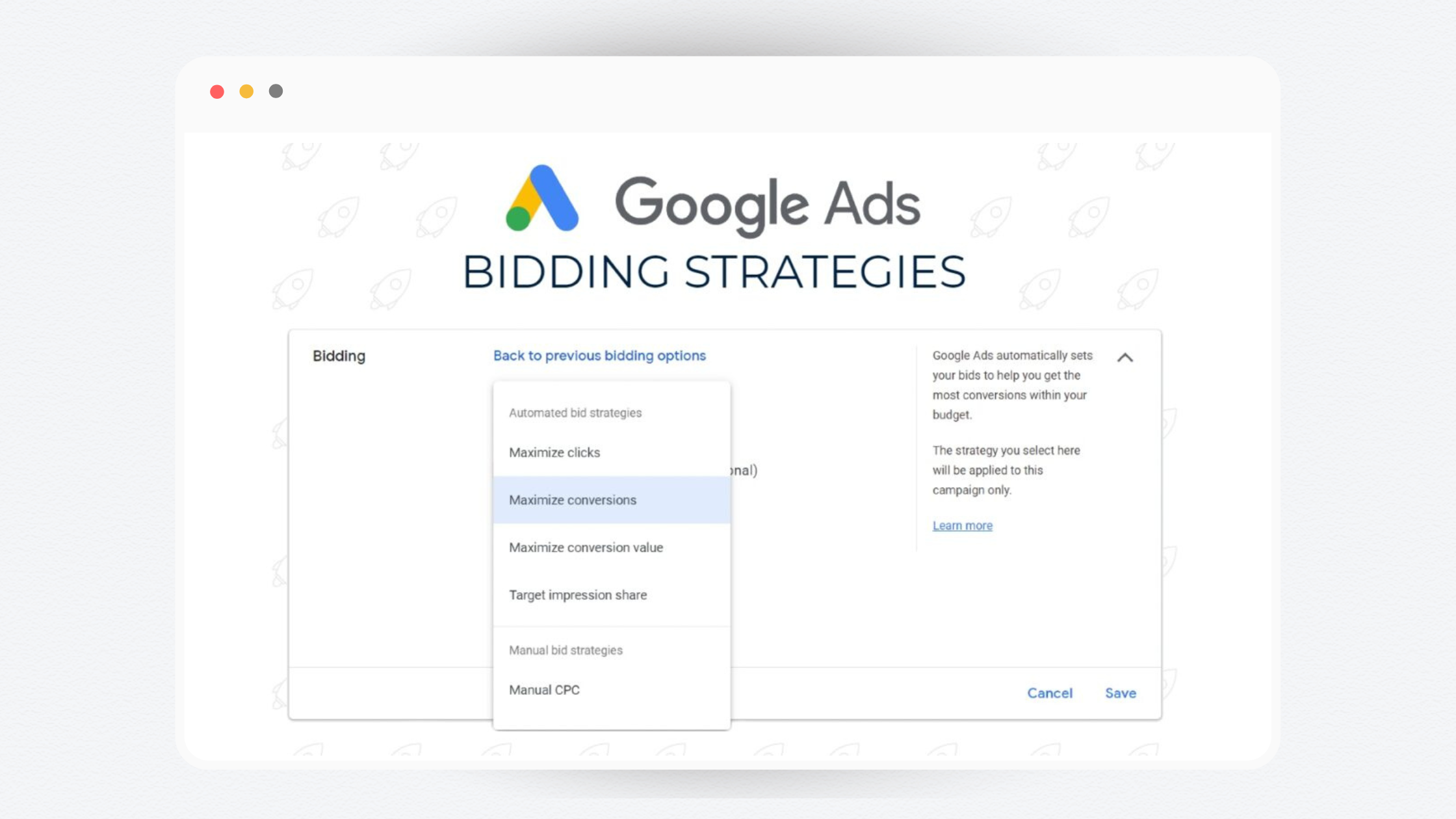
This is where the ad platform or a third party tool automatically adjusts bids or budgets based on machine learning. Examples include Google Smart Bidding strategies like Target CPA and Maximise Conversions, and platforms that automate bidding for Facebook Ads, Microsoft Ads, or programmatic channels. These systems use signals such as search query, device, time of day, past behaviour, and conversion likelihood to set bids in real time.
Manual bidding
Here, you set bid amounts and budgets yourself, and make adjustments based on your analysis. This can be granular at the keyword level for search campaigns or at the ad set level for social campaigns. Manual bidding gives you direct control over where and how much you spend.
Strengths and Weaknesses at a Glance
AI driven bidding
- Strengths: Scales fast, good for dynamic optimisation, reduces time spent on bid minutiae, can find pockets of conversions humans miss.
- Weaknesses: Requires good data to learn, can overspend on low value conversions if not configured, less transparent decision making.
Manual bidding
- Strengths: Full control, predictable spend on specific keywords or audiences, easier to match bids to margin priorities.
- Weaknesses: Time intensive, slower to adapt to changing conditions, limited by human pattern recognition.
How to Choose?
Think of bidding choice as a function of three things: data volume, campaign objective, and margin tolerance.
- Data volume: AI needs conversions to learn. If you get fewer than 30 conversions per month in a campaign, manual bidding or a hybrid approach is safer.
- Campaign objective: Use AI for broad scale awareness and conversion volume. Use manual bidding for high value or niche SKUs where each sale matters a lot.
- Margin tolerance: If you have thin margins and every cent matters, manual bidding lets you guard spend tightly. If you can afford exploration to find scale, AI can uncover profitable opportunities.
Now for the hacks that actually help you stretch your budget!
Budget Hacks When Using AI Driven Bidding
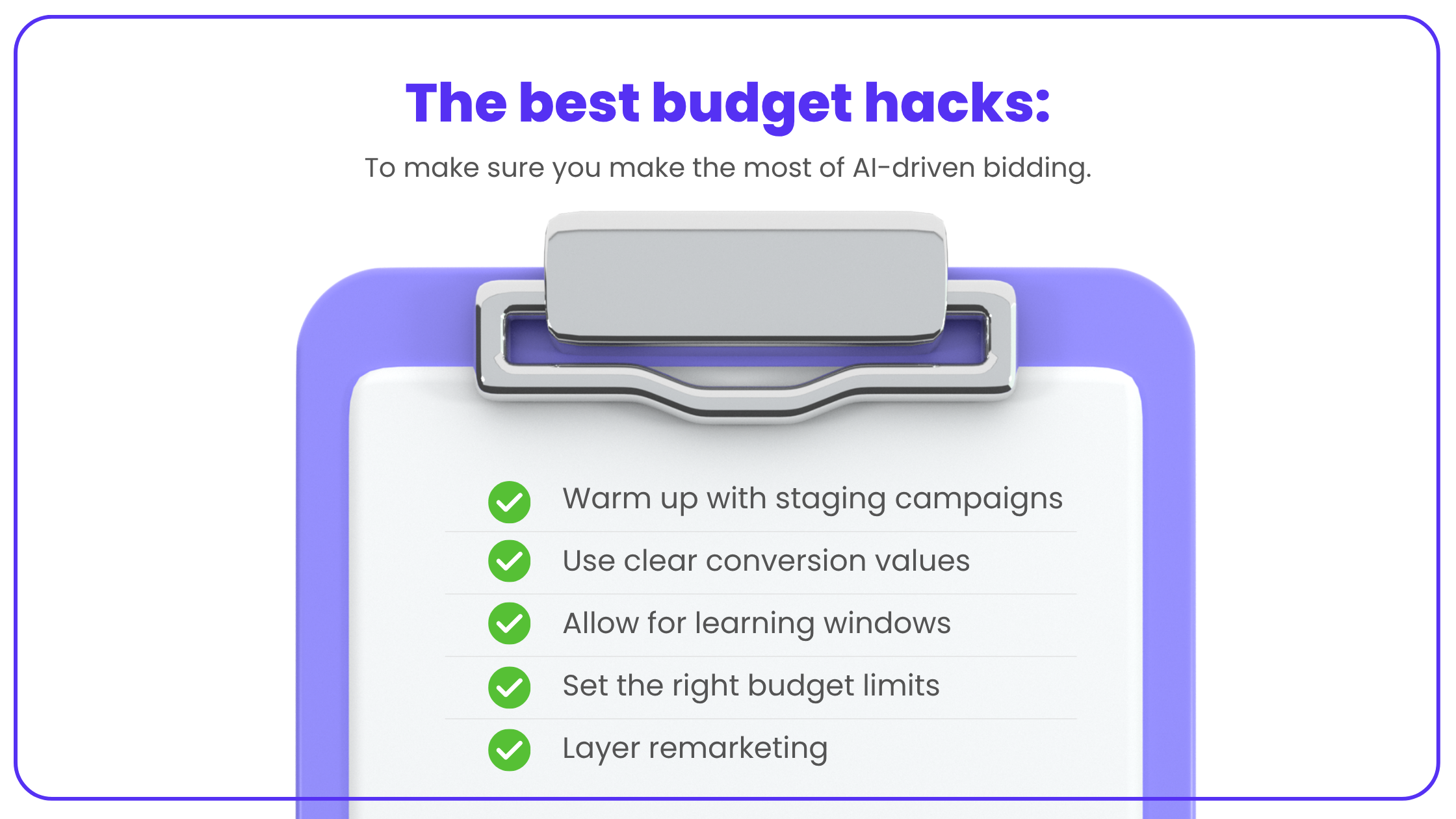
Warm up AI with staging campaigns
Before switching your core campaigns to automated bidding, create a warm up period. Run a small budget manual campaign to gather 50 to 200 conversions over a few weeks. This gives AI quality data to learn from. If your store is very new, invest a small exploratory budget to find initial winners before handing control to automation.
Use clear conversion values
Teach the AI what success looks like by setting accurate conversion values. Not all purchases are equal. Assign higher conversion values to high margin products and include lifetime value where possible. Platforms respond better when they can optimise toward revenue, not just conversion count.
Start with a conservative target
When using CPA targeting or ROAS targets, start slightly more conservative than your goal. For example, if your target CPA is $20, experiment with $18 to give the algorithm room to test cheaper wins first. If you start too aggressive the AI may overbid trying to hit that target quickly.
Use seasonality adjustments and learning windows
If you run promotions or seasonal sales, inform the platform. Google Ads and some DSPs let you set seasonality adjustments or expected changes in conversion rate. This prevents the algorithm from overreacting and spending heavily when things are temporarily better or worse.
Monitor distribution not just averages
AI can skew spend toward a few high performing audiences. That is usually fine when scaling, but if you rely on a narrow slice of traffic you risk volatility. Check spend distribution across devices, locations and audiences. Cap or exclude channels that drive expensive conversions to keep the budget efficient.
Set sensible bid caps and budget limits
Most smart bidding systems allow bid or spend limits. Use them. Cap bids for expensive audiences and set daily budget limits while the algorithm learns. You avoid early overspend while giving the system a clear ceiling.
Use value based bidding instead of volume based
If possible, switch to value based bidding, such as Target ROAS or maximise conversion value. For ecommerce, optimising for revenue usually beats optimising for conversions if your product prices vary. Value based bidding directly aligns the ad spend with your bottom line.
Layer remarketing and dynamic creatives
AI loves signals. Use dynamic product ads and layered remarketing so the algorithm can match intent signals to the right product with the right creative. This usually reduces CPA and increases conversion value without extra budget.
Test single variable changes
When experimenting, change one variable at a time. Switch an audience, adjust the target ROAS, or change creatives individually. The AI will respond, and you can attribute wins or losses correctly.
Let AI run full learning cycles
Most platforms have a learning phase. Resist the temptation to change bids or budgets daily. Allow at least one to two weeks or 50 to 100 conversions for the algorithm to settle before evaluating performance.

Budget Hacks for Manual Bidding
Use the Pareto rule on keywords and products
About 20% of your keywords or products will drive 80% of sales. Identify that 20% then focus manual bid attention there. Increase bids on those winners and cut bids or pause the long tail until you can scale testing.
Bid by margin not price
Set bid ceilings based on margin contribution, not the product price. A $50 sale with a 30% margin can absorb higher ad spend than a $100 sale with a 10% margin. Create a simple formula to calculate maximum acceptable CPA per product or product group.
Time of day and day of week adjustments
Manual bidding gives you fine control over when you appear. Analyse conversion performance by hour and day and schedule higher bids for peak windows and lower bids or pauses for low performance hours.
Geo targeted bid adjustments
If certain regions convert better or have lower shipping costs, prioritise them. Increase bids where ROI is strong and reduce bids in poor performing locations.
Use negative keywords aggressively for search
Protect your budget by auditing search terms regularly and adding negatives for irrelevant or low intent queries. This stops wasted clicks and keeps the bid budget focused on intent that converts.
Rule based automation
Even when you stay manual, use simple automated rules. For example, if CPA exceeds X for three days in a row, reduce the bid 10%. If CTR falls below Y, pause the creative. Rules save time while maintaining manual control.
Bid by product lifecycle
New products often need exposure. Allocate a higher initial bid for new SKUs to gather data, then reduce bids as the product matures. Conversely, reduce bids for ageing inventory that you want to clear only when the margin supports it.
Use incremental lift tests
Test bid changes incrementally to avoid big swings. Raise bids by 10 to 20% to assess impact and roll back if CPA goes up too much. Small moves prevent sudden budget drains.
Leverage long tail and low cost keywords
Long tail keywords often have lower CPCs and better intent. Manually find and bid on niche queries related to your products. These small wins add up and are cheaper to scale.
Daily micro checks and weekly deep dives
Spend 10 to 20 minutes each day on quick checks and one longer session weekly to dig into trends. Manual bidding requires discipline but that cadence keeps cost leakage to a minimum.
Hybrid Approach Hacks
You do not have to pick a side. A hybrid approach often gives the best budget efficiency.
Segment by funnel stage
Use AI driven bidding for bottom of funnel and conversion campaigns with good data. Use manual bidding for top of funnel awareness or niche product campaigns where control matters.
Use AI for scaling winners
When a manual campaign proves profitable, clone it and hand the clone to AI for scaling. Keep a smaller manual version running to protect the original performance baseline.
Different bids for different Stock Keeping Units (SKUs)
High volume, low margin SKUs can be left to AI value based bidding to maximise revenue. High margin, low volume SKUs get manual bids to protect profitability.
Coordinate creatives and bids
Let AI optimise bids while humans optimise creatives. Strong creative lowers cost per conversion. Use human writers and designers to test winning angles while the AI finds the audiences.
Measuring Performance and Guarding Your Budget
Track the right KPIs
Do not obsess over clicks. Track conversion value, ROAS, and cost per acquisition. Add margins into your return calculations so you know when a conversion is truly profitable.
Use cohort analysis
Look at new versus returning customers, average order value over time, and retention. AI might optimise for cheap new customers that do not return. Cohort metrics tell the true lifetime value.
Monitor churn in automation
When you hand control to AI, monitor for sudden changes in acquisition channels. If the AI starts favouring low value traffic, adjust targets or exclude those channels.
A/B test bidding strategies
Run experiments comparing manual versus AI driven bidding on similar campaigns. Use statistically significant periods and ensure budgets are comparable. Tests help you decide where automation adds value and where manual still pays off.
Practical Setup Checklist
- Do you have at least 30 conversions per month in the campaign? If not, start manual or use a hybrid.
- Have you set realistic conversion values and margins in your tracking? If not, do that first.
- Did you set bid caps and daily budget limits before enabling AI? Always set them.
- Is your creative library ready with dynamic assets and multiple variations? AI performs better with variety.
- Have you scheduled rules and alerts for overspend? Use platform rules or third party tools.
- Are you running regular negative keyword and search term audits for search campaigns? Do them weekly.
AI driven bidding is a powerful lever for ecommerce stores, especially when you want to scale and you have reliable conversion data. But it is not a magic switch. Manual bidding still wins when you need tight control over margin, when data is scarce, or when campaigns are niche. For most ecommerce stores, the best play is pragmatic hybridisation. Warm up AI with good data, set sensible caps and values, and use manual techniques to protect margin and test new ideas.
Start small, measure clearly, and iterate. With the right mix of automation and human oversight you can make every pound count and grow your ecommerce store without burning your budget.
Let’s Make Your Ads Pay Off!
At Digital Freak in Melbourne, we design and build websites, craft brands, run Google and social ads, and write standout content that converts. We help small and medium ecommerce stores save ad budget and scale profitably with practical, human-led strategies.
Ready to grow? Book a free strategy call and let’s make your ads work smarter.
FAQs
What budget do I need to start using AI bidding for my ecommerce ads?
You can begin with as little as A$700 to A$1,500 a month, though AI performs best with 30 to 50 conversions per campaign. Our digital agency in Melbourne can handle campaign setup, creative, tracking, web design and content. Book a free ads strategy call.
How long does it take for AI bidding to learn and perform?
Most platforms need two to four weeks or 50 to 100 conversions to exit the learning phase. Our digital agency in Melbourne will optimise tracking, creatives and landing pages via web design, content and ads to speed learning. Contact us for a free strategy call.
Can AI bidding save me money compared with manual bids?
Yes, if you have enough conversion data and clear conversion values. AI often finds cheaper conversions at scale, while human oversight ensures margin protection. At our digital agency in Melbourne, we combine Google and social ads with brand and content improvements to improve ROI. Get in touch with us for a free strategy call.
How do I protect profit margins when using automated bidding?
Set accurate conversion values, use target ROAS, cap bids and exclude low value audiences. Our Melbourne digital agency will audit margins, update product tagging and optimise landing pages via our web and content services to align bidding with profitability. Book a free strategy call.

When clients work with me, they get exactly what they want - no-nonsense, authentic digital marketing that works! With my industry experience, eye for detail, and a team that goes the extra mile, every client gets the personalised, expert treatment they deserve. Let’s get you online – and growing!